Screening at 75 and beyond isn't about following a fixed programme - it's about making thoughtful, personalised choices that reflect your health, your priorities, and what matters most to you. This page outlines the options that may still be relevant at this stage, so you can have that conversation with confidence.
Please note: These are imaging-based pathways available within our private radiology setting. They are in addition to, and do not replace other screening programmes offered through Health New Zealand.
Screening options
Routine aortic screening isn't currently recommended for the general female population, however, this remains an area of ongoing research - recommendations may evolve as new evidence emerges.
That said, if you have specific risk factors - such as a strong family history of aneurysm, a history of smoking, certain genetic or connective tissue conditions, or symptoms that are causing you concern - it's worth raising this with your doctor. A referral for a vascular ultrasound may be appropriate to help assess your individual situation.
If you are a current or former smoker, annual low-dose CT (LDCT) may be worth considering up to the age of 80.
LDCT is a quick, non-invasive scan that can detect lung cancer at an early stage - before symptoms develop, and when treatment options tend to be at their broadest. It uses less radiation than a standard CT and requires no injections or sedation.
For those with a significant smoking history, it offers a proactive and straightforward way to keep a closer eye on lung health, with the reassurance of knowing results are reviewed by experienced specialists.
CT Colonography remains one of the best tools available for assessing the bowel, though at this stage of life it's best considered in the context of your overall health and in discussion with your doctor about whether it's the right fit for you.
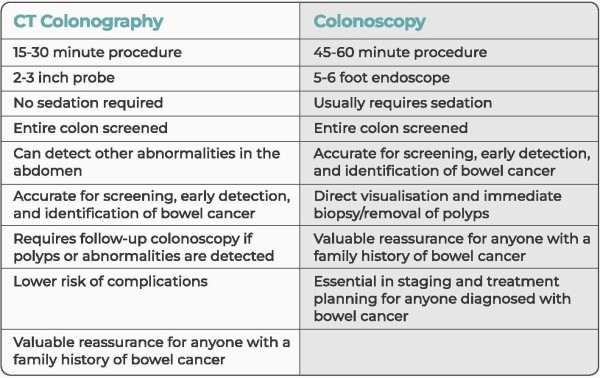
When it is appropriate, CT Colonography is a safe, effective, and considerably more comfortable alternative to traditional colonoscopy - with no sedation required, a shorter procedure, and a faster recovery. In New Zealand, it also offers a practical advantage: shorter waiting times compared to conventional colonoscopy, meaning you can access bowel screening without unnecessary delay.
CT Colonography is a fast, accurate, and less invasive alternative to colonoscopy. See the comparison below for more information.
You may have heard that WB-MR is able to ‘check for everything’ and find disease early. While it can be used for screening or early detection in some situations it is not a complete test for all diseases, and it's important to understand its limitations.
Currently there is no evidence to demonstrate significant improvement to your health outcomes using whole‑body MRI as a screening tool. It can also identify incidental or low‑risk findings that may lead to unnecessary anxiety and follow‑up tests. In addition to this, not all diseases are detectable on whole‑body MRI - particularly in the early stages - which can offer you false reassurance.
Whole-body MRI may be appropriate:
- As part of specialist-led care or surveillance
- In high-risk genetic conditions such as Li-Fraumeni Syndrome (inherited TP53 loss)
- For specific medical reasons, such as inflammatory or systemic disease
We recommend screening that is targeted, and evidence based, matched to your own risk profile, and using imaging that’s known to improve outcomes (such as bowel, lung and the other screening options defined above).
If you believe a whole-body MRI may be appropriate for you, please discuss the potential benefits, limitations, and suitability of the test with your doctor and arrange a referral to book your appointment with us.